How long do weed cravings last, and how do you ride one out?

A single weed craving usually peaks within a few minutes and passes in 15 to 30 minutes if you don't act on it. Over the bigger picture, cravings are most frequent in the first two weeks after quitting, become tied to specific situations after about a month, and are usually rare and brief by month three.
The first number is the useful one. A craving feels like it will keep building until you give in, but it doesn't. It rises, peaks and falls.
What a weed craving actually is
Cravings come in two kinds. Withdrawal cravings are the steady background pull of the first week or two while your body adjusts. Cue cravings are set off by something specific: a time of day, a place, a smell, a person, stress or boredom.
Cue cravings last much longer into recovery, because the habit is tied to those triggers. The good news is that each time you get through one without smoking, the link gets a little weaker.
How long weed cravings last over time
- Weeks 1 to 2: frequent, sometimes several in an hour during the evening.
- Weeks 3 to 4: less constant, but strong in trigger situations.
- Months 2 to 3: occasional, shorter and easier to brush off.
- After that: rare, usually linked to a specific cue or a stressful day.
Everyone's curve is a bit different, and heavy daily users often have a longer first phase. The full weed withdrawal timeline shows how cravings fit alongside sleep, mood and appetite.
Common triggers for weed cravings
Most cue cravings come from a short list. The time you used to smoke is the big one: the first hour after work, the end of dinner, the last hour before bed. Then there are places (your balcony, a friend's car), people you always smoked with, and feelings, especially stress, loneliness and boredom.
Good news can be a trigger too. A lot of people used weed to celebrate or unwind after a win, so a great day can bring a surprisingly strong pull. Once you know your own triggers, you can change the routine around them, like eating dinner somewhere else or going for a walk at 9pm.
How to ride out a weed craving
The goal is to get through the next 15 minutes, not to never want weed again.
- Name it. Say "this is a craving, it'll pass" in your head. It sounds silly and it helps.
- Rate it from 1 to 10. Putting a number on it turns it into something you watch rather than something that drives you.
- Change your setting. Go outside, move to another room, take a shower.
- Keep your hands busy for 15 minutes with dishes, a walk or a game.
- Check back in. Most of the time the number has dropped.
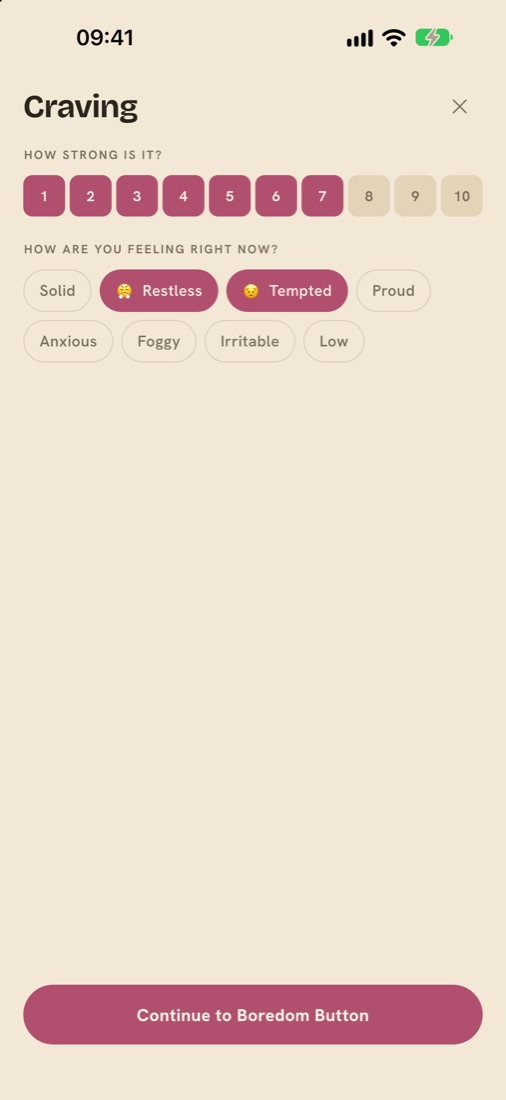
Why logging cravings helps
Writing cravings down shows you the pattern behind them. After a week or two you might see that most of yours hit between 9 and 11pm, or after a stressful call with work. That's something you can plan around.
Foglift's stats screen charts cravings resisted per day and how strong they were, so you can watch the line drift down over the weeks. It's one of the more encouraging things to look at on a bad evening.
More questions
Why do weed cravings come back months later?
Usually because of a cue: a place, a song, a stressful week or an old friend. A late craving doesn't put you back at the start, and it tends to pass faster than the early ones.
Do weed cravings ever go away completely?
For most people they become rare enough that they stop mattering. An occasional passing thought can stay for a long time, but it loses its pull.